Agility in Action: SpEC Member Successes Powering the Space Mission
January 26, 2026
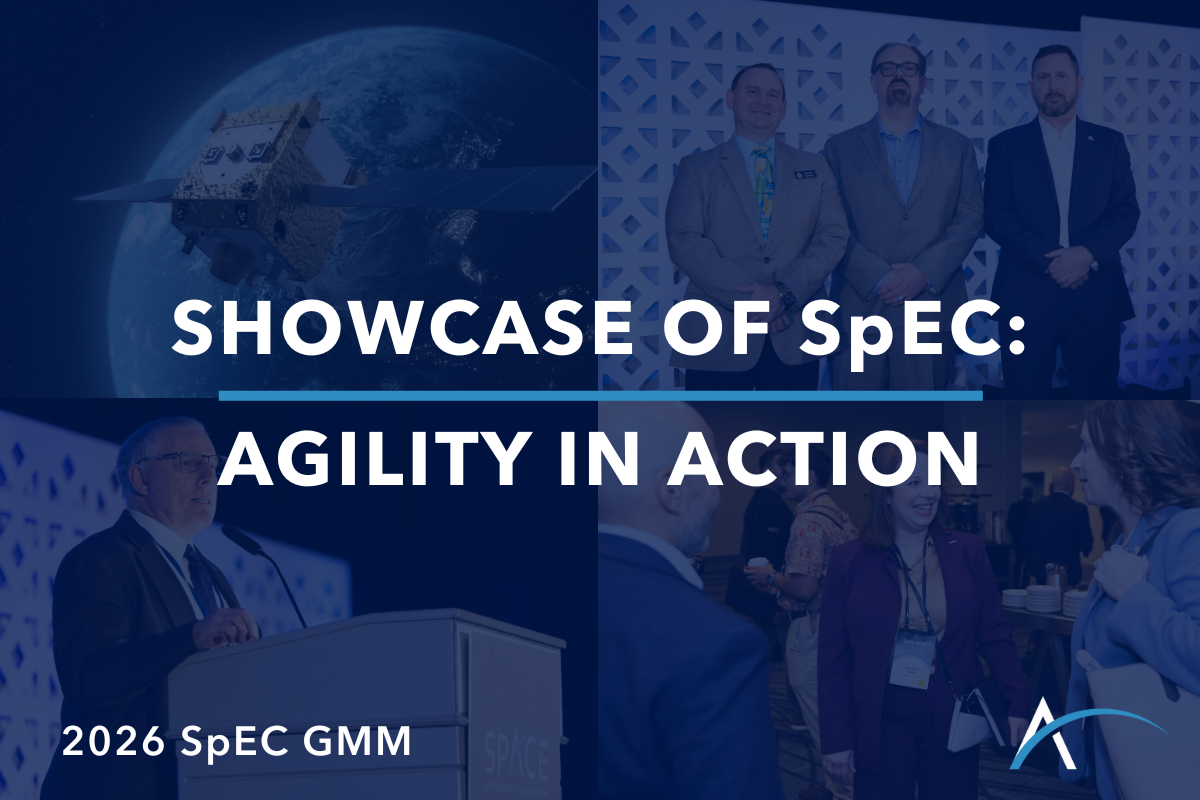
Against the backdrop of Los Angeles, Space Enterprise Consortium (SpEC) members and government partners gathered for an evening that put the 2025 mission successes front and center. As a part of the 2026 SpEC General Member Meeting (GMM), the Showcase of SpEC: Agility in Action highlighted how SpEC members are translating urgent space defense needs into real, operational capabilities at speed. From rapid prototyping to field-ready solutions, the showcase told a clear story: over the past year, SpEC’s collaborative model has not only accelerated innovation for its members but also delivered tangible value to the U.S. space mission when it mattered most.
SpEC’s Past, Present, and Future
SpEC’s story is one of evolution driven by urgency. Founded in 2017 to accelerate space acquisition through collaboration, the consortium quickly outgrew its original construct as demand for faster, more flexible solutions surged. That pressure helped shape the scalable Other Transaction Authority (OTA) SpEC model, designed to deliver speed without sacrificing accountability. In 2025, that model reached a new level of maturity, enabling members to move from concept to capability while directly supporting the U.S. Space Force’s most critical priorities across areas such as Space Domain Awareness, battle management, and space logistics.
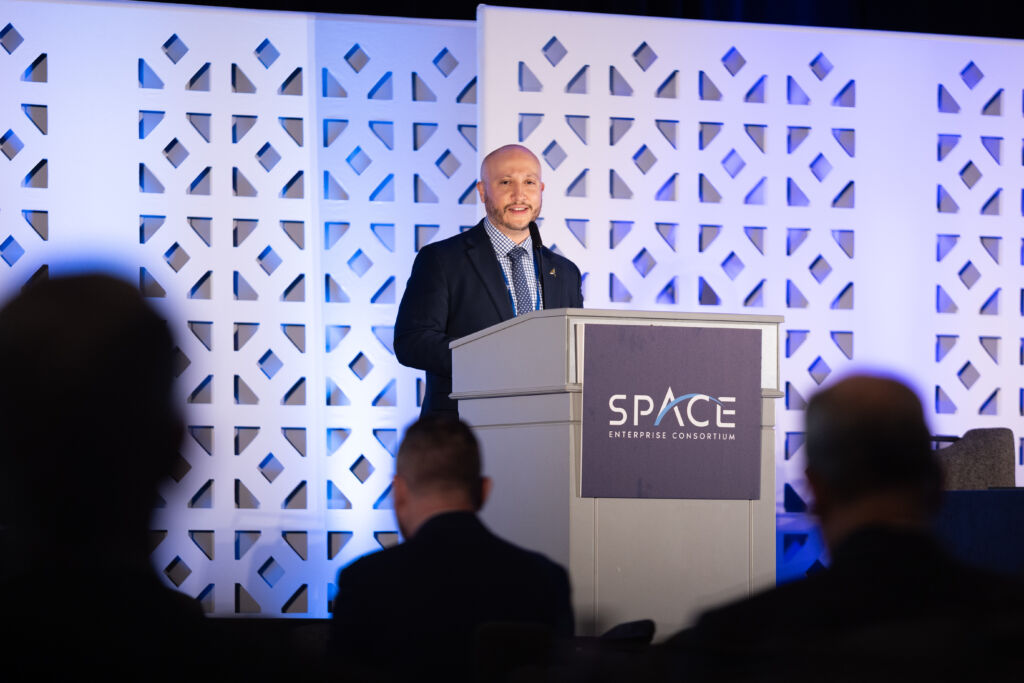
Mr. Enrico P. Jeantete, Deputy Director for the Innovation and Prototyping Acquisition Delta, SSC, presents on the history of the SpEC OTA.
The past year marked SpEC’s most impactful period to date. In 2025 alone, the consortium awarded five new prototyping projects addressing some of the U.S. Space Force’s most pressing challenges, totaling more than 121 projects since its inception. Spanning technology areas from Space Domain Awareness (SDA) to Battle Management, Command, Control, and Communications (BMC3), these efforts reflect an expanding confidence in SpEC’s ability to deliver at the pace the mission demands. What once began as an alternative pathway has become a proven engine for rapid space defense acquisition.
Member Showcase: Unveiling SpEC Successes
The SpEC momentum was on full display during the Showcase of SpEC, where selected member performers took the stage to share the tangible results of OTA-enabled collaboration. Rather than deep technical briefings, presenters offered clear, mission-focused snapshots of how their solutions are progressing from prototype toward operational relevance. Together, Joint Antenna Marketplace (JAM), Space Mobility and Logistics (SML), and Data Exploitation and Enhanced Processing–Radio Frequency (DEEP-RF) offered a compelling snapshot of how SpEC members are translating complex mission needs into operationally relevant solutions.
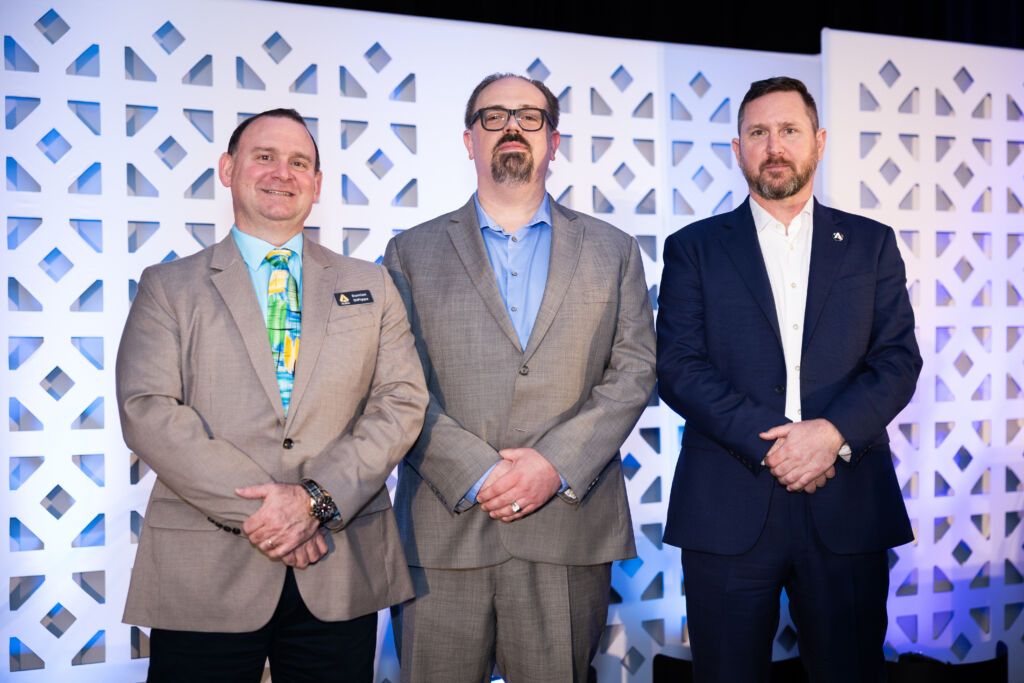
Showcase of SpEC Member Presenters from Left to Right: Damian DiPippa (Auria Inc), Mike Felix (NIUSG), Dennis Wille (Astroscale U.S.)
Joint Antenna Marketplace (JAM)
Damian DiPippa, CEO of Auria, Inc, kicked off the member presentations with a showcase of the JAM program. Awarded in 2025 under Space Systems Command (SSC)’s BMC3I program office, Auria is developing a JAM operational prototype to deliver a secure, cloud-based application connecting Satellite Operations Centers (SOC) to government and commercial antennas.
“The JAM solicitation reflects SpEC’s ability to rapidly acquire technology.”
Teaming for JAM Success
The JAM solicitation highlights SpEC’s ability to rapidly acquire cutting-edge technology while supporting non-traditional defense contractors like Auria, Inc. By leveraging strategic teaming opportunities, companies were able to submit stronger, more competitive proposals. Key events such as Industry Day, Project TALX, and Innovator NETWORX provided valuable opportunities for collaboration and networking. The JAM team, Auria, Inc., and Defense Unicorns, demonstrated how effective partnerships can accelerate innovation and drive mission impact.
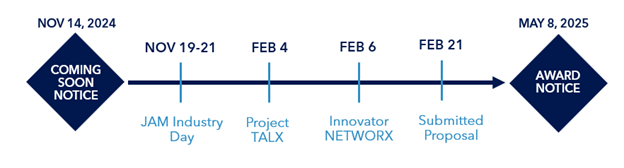
The JAM solicitation timeline, from Coming Soon notice to Auria, Inc’s award notice.
Space Mobility and Logistics (SML)
Dennis Wille, Senior Director for National Security Business Development at Astroscale U.S., presented on the SML program, a critical U.S. Space Force effort to improve space mission design.
“The SpEC OTA enabled this program to be adaptable to evolving USSF needs for its refueling mission.”
Awarded in 2023 to Astroscale U.S. Incorporated, SML accelerated in-space capabilities, including refueling, transportation, servicing, and debris mitigation. The SML prototype project enables the movement and support of military equipment and personnel in and through the space domain. It has since seen the successful delivery of the Provisioner ™, the Astroscale U.S. refueler. This was the first-ever refueling of a U.S. Space Force asset.
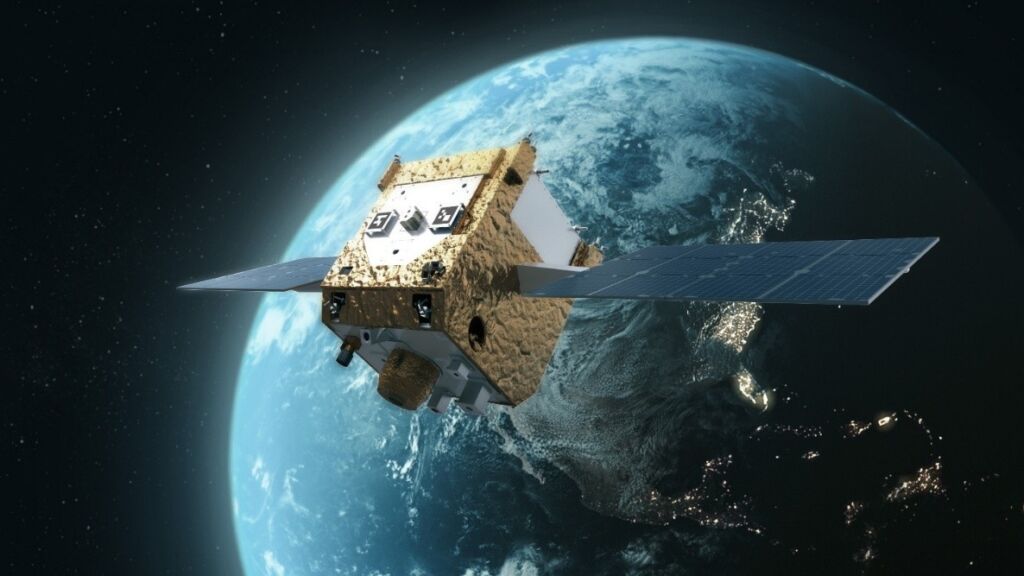
Provisioner ™, the Astroscale U.S. Refueler. Photo credits to Astroscale U.S.
Data Exploitation and Enhanced Processing – Radio Frequency (DEEP-RF)
To close out the showcase, Mike Felix, Vice President of Advanced Programs at Network Innovations U.S. Government (NIUSG), gave a compelling presentation on the DEEP-RF program. DEEP-RF, awarded in 2024, was created by SSC to support uncooperative geosynchronous and Low-Earth Orbit satellites.
“Through their disciplined management of the DEEP-RF program, the SpEC team created considerable value for the government.”
The DEEP-RF team acquired SDA/Satellite Communications Situational Awareness (SATCOM-SA) data in commercial frequency bands over Europe and Pacific geographic regions. With this data, DEEP-RF brought new ground sites and technology providers to the underserved RF Sensing area of UDL and Global Data Marketplace. The program was successfully delivered between November 2024 and December 2025
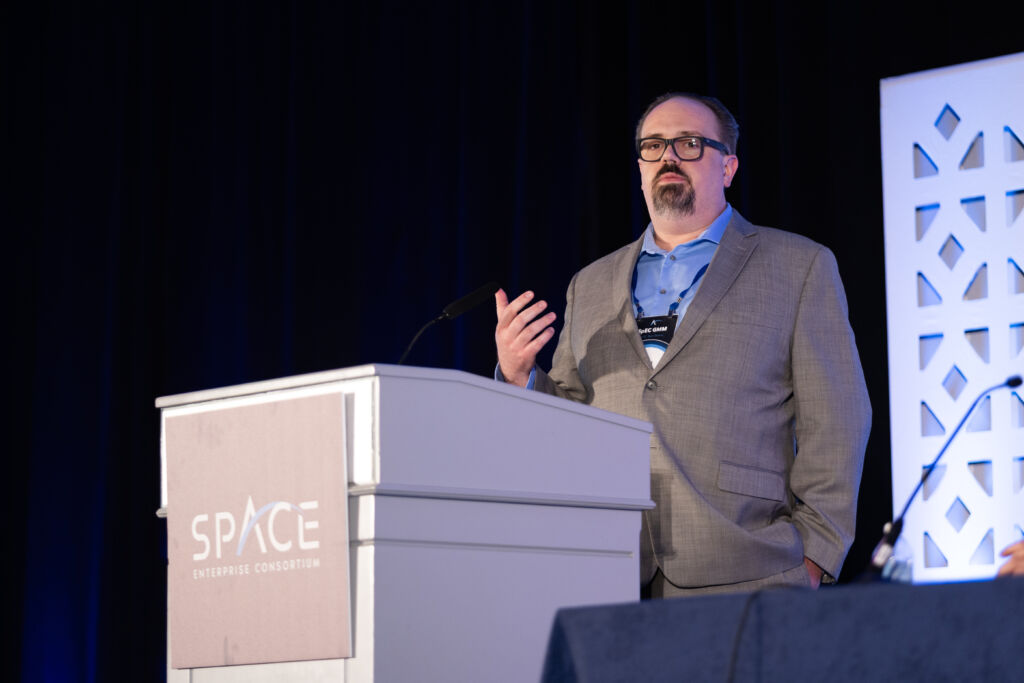
Mr. Mike Felix, NIUSG, explains the advancements to space defense through DEEP-RF
The Impact of SpEC on DEEP-RF
For DEEP-RF, SpEC’s clear data rights framework and flexible OTA execution enabled rapid progress without sacrificing discipline. By incorporating end-user feedback and executing quick agreement modifications, SpEC allowed NIUSG to integrate additional teammates and commercial solutions as requirements evolved, keeping the program on track while delivering expanded, non-classified capabilities with real mission value.
Agility That Delivers
The 2025 Showcase made one thing clear: SpEC’s model works. From JAM’s rapid antenna connectivity to SML’s first-ever in-space refueling and DEEP-RF’s expanded SDA capabilities, members are turning urgent needs into operational results on rapid timelines. By combining agility, collaboration, and disciplined execution, SpEC proves that its OTA-driven approach is a powerful engine for U.S. space mission success. As 2026 begins, the consortium is poised to turn the next wave of innovation into real, mission-ready impact. Learn more about SpEC and how members are driving space innovation.
About SpEC
The Space Enterprise Consortium (SpEC) was created in 2017 through the Air Force Space Systems Command to bridge the gap between military buyers and commercial space startups and small businesses through OTAs. Companies interested in joining the Space Enterprise Consortium can find more information about the organization, including how to join at https://www.space-enterprise.org.